
 Lukas Frotscher
An article by Lukas Frotscher, L.F.N. team Freiburg, member of working group NA 001-01-02-11 AK “Revision of DIN 45680” of the DIN/VDI Standards Committee Acoustics, Noise Control and Vibration Engineering (NALS).
Imagine a dog barking while you stand 5 metres away and hear the noise. The barking can be recorded with a sound level meter, which objectively reproduces the physical signal in numbers (measured values).
What you hear of it is subjective, psychological or mental hearing and can differ from the measured result. The objectively measurable sound event is called the stimulus, while subjective hearing is called sensation. The scientific discipline that investigates the relationship between stimulus and sensation is perceptual psychology. If the stimulus can be quantified precisely in physical terms, this is also called psychophysics. To find out, for example, at what volume a tone can still be heard, the following experimental setup is suitable:
The experimental setup
A number of randomly selected, representative test subjects are invited to a laboratory. There they are given headphones through which various sounds (often sine tones) can be played.
Tones of different pitches are then played through the headphones. The tones start very quietly and become louder and louder. The subjects are asked to press a button as soon as they can perceive a tone. This makes it possible to determine how loud a tone must be in order to be heard.
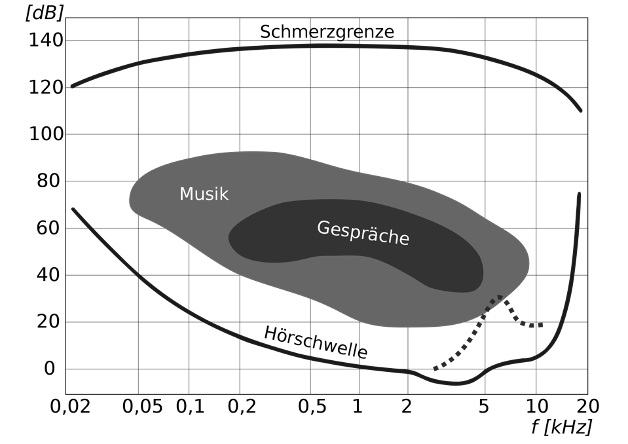
This procedure for determining individual hearing ability is also familiar from the ear doctor. In this experimental setup, the same experiment is carried out on many different people and an average is formed from the results. This makes it possible to say in general what can be heard on average. In this way, the hearing threshold, often also called the perception threshold, is determined. As the hearing threshold depends on the frequency of a tone, the curve shown here results.
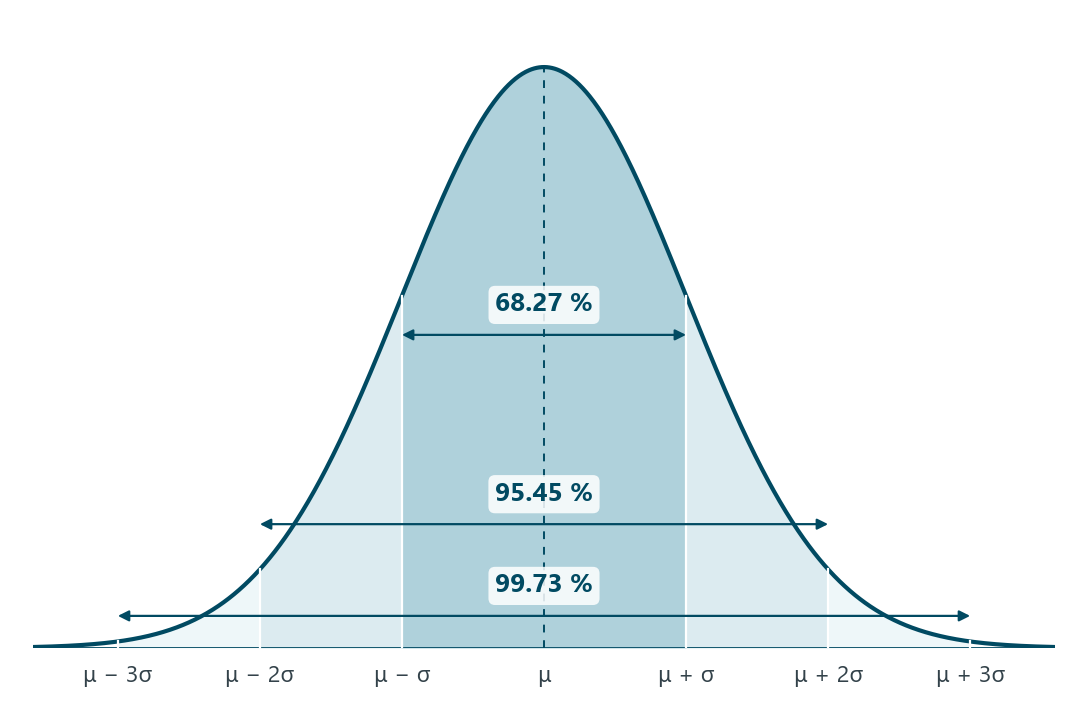
The measurement data underlying the hearing threshold are normally distributed, i.e. they form a Gaussian curve. This means that the individual hearing ability of 68.27 % of the subjects is represented by the general hearing threshold to within one standard deviation, and that of 95.45 % to within two standard deviations. This in turn means that only 4.55 % of the population deviate from the hearing threshold by more than two standard deviations.
It follows that the hearing of very few people is significantly better or worse than represented by the hearing threshold.
The following links provide further information on this topic (in German):
scribbr.de/statistik/normalverteilung
scribbr.de/statistik/standardabweichung
What about infrasound?
The special feature of infrasound is that it cannot be heard at normal sound pressure levels. A tone can only be heard at very high sound pressure levels. However, there are repeated reports that the effects of the sound can be felt even at lower levels. This observation gives rise to the following distinction:
- Hearing threshold (often called the perception threshold): the tone can be perceived as such.
- Threshold of tactile perception: the tone cannot be perceived as such, but the effects of infrasound (such as pressure on the ears or headaches) can be felt.
Conclusion
The objective sound event, the stimulus, and its subjective perception, the sensation, can differ. The reason for this phenomenon is the individual hearing ability of the person exposed to a stimulus. When the average hearing threshold is determined, it is noticeable that about 95 % have a comparable sensation and only just under 5 % lie significantly above or below the average hearing threshold. In addition to the hearing threshold, which relates to acoustically audible stimuli, the threshold of tactile perception is relevant for infrasound. It relates to the subjectively perceptible physical and mental effects of stimuli that cannot be perceived acoustically.