
 Lukas Frotscher
An article by Lukas Frotscher, L.F.N. team Freiburg, member of working group NA 001-01-02-11 AK “Revision of DIN 45680” of the DIN/VDI Standards Committee Acoustics, Noise Control and Vibration Engineering (NALS).
As there is currently a great deal of discussion about infrasound, i.e. sound below the human hearing limit of 16 Hz, our measurement team decided to generate it ourselves, so that we would no longer just read about it but experience it first-hand. But how do you produce such a low tone, given that conventional sound systems cannot reproduce frequencies in this range?
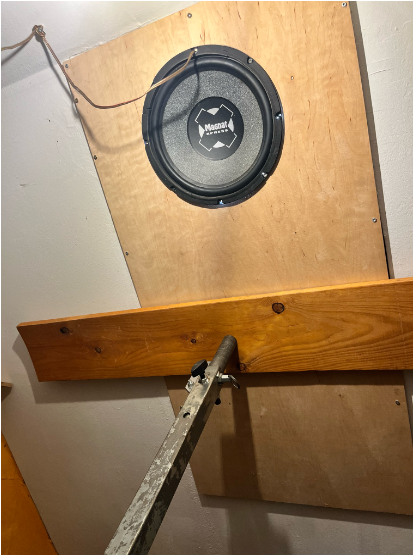
The answer came from my friend, the sound engineer Sebastian Duis. If you turn the entire room you are in into the loudspeaker itself, infrasound signals can be produced. This is done by removing a window, fitting a wooden board in its place, sawing a hole in it and mounting the driver in the hole. This design is called an “infinite baffle”.
With the right power amplifier and a sine-wave generator, tones below 16 Hz can finally be produced. We tested various frequencies; 5 Hz was the lowest that still gave clear results on our Svantek 977 meter (Class 1, calibrated). We therefore chose 5 Hz as the test tone for the following experiment.
Recommended: “Sound perception”, subjective and objective sound perception and how it works
Experiment
Perception threshold of infrasound:
The signal fed to the loudspeaker consisted of an oscillation of exactly 5 Hz, supposedly without any harmonics. However, our meter showed that the harmonics of 5 Hz (integer multiples of 5 Hz, i.e. n × 5 Hz) were also produced.
Why is that? Once the driver sets the wooden board vibrating at 5 Hz, the board then produces the harmonics (compare a vibrating string). Although we had not intended this, it was to be expected, as with the construction shown above it is very difficult to mount the board so rigidly that it does not vibrate along. At first we thought this was a problem for our experiment, but then we realised it was actually an advantage, as pure sine tones are extremely rare in nature and our experiment therefore became even more realistic.
Typical experiments in perceptual psychology for determining the perception threshold of tones always use sine tones (Sound perception: experimental setup). However, the question remains whether these values also apply in everyday life, as pure sine tones rarely occur. Perception processes are therefore often more complex in nature, in terms of the ability to identify structures and ordering principles in sensory impressions.
Our experimental setup therefore looks as follows:
The signal actually produced, which serves as our stimulus, consists of the frequencies 5 Hz, 10 Hz, 15 Hz, 20 Hz and so on, with the fundamental of 5 Hz always being the loudest and the harmonics becoming successively quieter with increasing frequency. In addition, the whole house certainly vibrated along, producing very quiet rattling noises etc.
To simulate an even more realistic situation, we went one floor down, as infrasound often comes from another room, floor or even from outside the house. In addition, the ceiling in between acts as a low-pass filter, so that higher frequencies are filtered out.
The three of us then determined whether we could perceive anything. It did not matter whether we could hear the tone or only feel it, or both. Our sound engineer then switched the tone on at different volumes for at least ten seconds. As soon as we could register the tone in any way, this was noted.
Results
Result 1 – continuous signal
(The dB values are unweighted and refer only to the 5 Hz fundamental measured at head height):
Next, our sound engineer pulsed the signal, i.e. switched it on for a very short time and immediately off again. The result was as follows:
Result 2 – pulsed signal
Conclusion
The perception thresholds are thus 20 dB apart! As soon as the same signal is pulsed, it becomes perceptible 20 dB earlier. The contrast between “signal on” and “signal off” seems to be the reason for the increased perceptibility.
The perception threshold of infrasound determined in laboratory experiments lies between 90 dB (at 10 Hz) and 120 dB (at 1 Hz). There, only the exact sine tone without interfering noise and harmonics was used as the stimulus (LUBW).
In our experiment, in which the harmonics were produced as well, we arrive at 80 dB (at 5 Hz). If this signal is also pulsed, we end up at 60 dB. That is a huge difference.
This confirms the perennial problem that there is a big difference between laboratory and field experiments. The applicability of laboratory studies must therefore always be checked separately.
Our experiment and its findings certainly cannot claim the scientific rigour of a university study, but they give a first impression and point to a relationship that should be taken into account in the infrasound debate.