
 Lukas Frotscher
An article by Lukas Frotscher, L.F.N. team Freiburg, member of working group NA 001-01-02-11 AK “Revision of DIN 45680” of the DIN/VDI Standards Committee Acoustics, Noise Control and Vibration Engineering (NALS).
Most people know the effects of ordinary noise from their own experience. Spending too much time in a noisy environment is at least tiring for most people. Some will also report headaches, dizziness or other physical impairments. The influence of noise and the resulting impairments on the individual are well documented. Various studies deal with higher-frequency noise sources in this respect. But what about low-frequency noise sources?
Human hearing covers roughly the frequency range of 16/21 – 6000/20000 Hz. People hear best between 500 and 8000 Hz. Frequencies below 250 Hz are referred to as low-frequency, so-called low frequency noise (LFN). Frequencies below the actually audible range, i.e. in the range of 0.x – 16/21 Hz, are referred to as infrasound.
What do the studies say?
In their 2016 meta-study, Baliatsas et al. suggest that there is a link between LFN and self-reported annoyance. Especially when noise that could in principle be avoided is perceived permanently, it often causes irritation. According to this study, the same applies to the low-frequency range, especially with permanent exposure.
In their 2024 meta-study, Liang et al. describe a link between LFN and impairments of higher cognitive functions. No link was found between LFN and impairments of basic cognitive functions such as attention, memory and executive functions. The study confirms that low-frequency noise can also have certain effects over time.
Against this background, it can be concluded that LFN should not be emitted in arbitrary doses if this results in hazards, considerable disadvantages or nuisance for the general public or the neighbourhood.
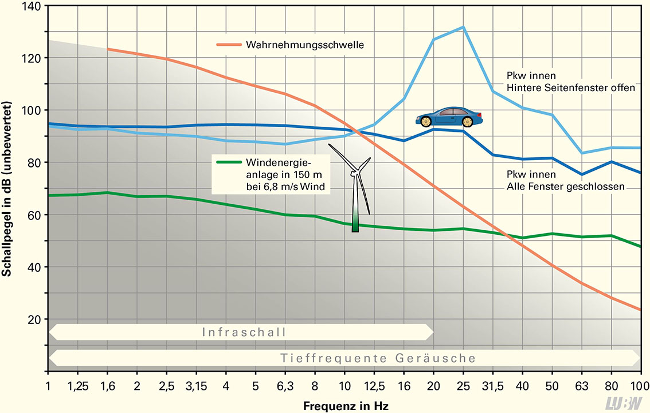
There are fewer studies on infrasound, as by definition infrasound cannot be perceived consciously. Conscious perception is only possible at very high sound pressure levels. The perception threshold is around 90 dB at 10 Hz and 120 dB at 1 Hz. At such levels, clear effects can also be observed in laboratory experiments.
Quote from LUBW (translated):
“Laboratory studies on the effects of infrasound show that high intensities above the perception threshold can be tiring, reduce concentration and affect performance. The best-documented reaction of the body is increasing fatigue after several hours of exposure. The sense of balance can also be impaired. Some test subjects felt insecure and anxious, while others had a reduced breathing rate.”
What are the effects below the perception threshold? The relevant range here is what can be felt below the hearing threshold.
The 2010 study by Salt and Hullar points out that infrasound events in this range do affect the ear. The outer hair cells can be stimulated by infrasound levels that are not yet consciously perceived. The claim that infrasound which cannot be heard has no influence whatsoever on the physiology of the inner ear is incorrect. Perception below the hearing threshold, within the range of what can be felt, is therefore an observable phenomenon.
How much does infrasound decrease with distance?
It is a well-known phenomenon that a perceptible noise becomes quieter with increasing distance from the source. This is mainly because, due to the spherical spreading of sound, the sound energy is distributed over a larger area and consequently decreases.
Quote (13db.de, translated):
“Doubling the distance between sound source and measuring point reduces the sound level in the free field by 6 dB.”
This applies to every frequency, i.e. also to infrasound. Depending on temperature and humidity, high frequencies are additionally attenuated more strongly in air than low frequencies. At 20 °C and 70 % humidity, 0.3 dB per km is absorbed at 125 Hz. This is therefore not significant and can be neglected in the following example calculation.
If, for example, an average of 60 dB of infrasound is measured at a distance of 150 m from a wind turbine, this means that only 42 dB arrives at a distance of 1.2 km.
| 150 m | 300 m | 600 m | 1.2 km | 2.4 km | 4.8 km |
| 60 dB | 54 dB | 48 dB | 42 dB | 36 dB | 30 dB |
The minimum distance between wind turbines and residential areas is between 750 m and 1250 m.
LUBW measurements at wind turbines
The State Institute for the Environment Baden-Württemberg (LUBW) has carried out a number of measurements on this topic. The following graphics are taken from the LUBW leaflet.
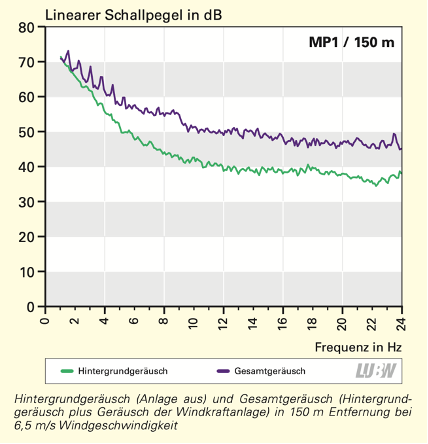
At a distance of 150 m, there is a clear difference between the background noise and the total noise (background noise plus turbine noise). The difference between the two curves therefore represents the turbine noise. This means that the infrasound emitted by the turbine can be clearly distinguished from background noise (such as wind). Particularly interesting is the sawtooth-like pattern below 8 Hz, caused by the uniform movement of the rotor blades, which appears as a fundamental with harmonics.
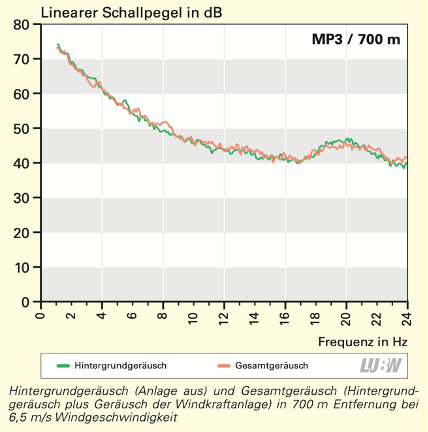
If the same measurement is carried out at a distance of 700 m, the two curves lie on top of each other. This means that switching on the turbine increased the measured infrasound level only marginally.
It is important to note that the levels are averaged over time. Wind noise is random and fluctuates strongly, while wind turbines produce periodically recurring, impulsive tones. This difference is lost through averaging over time.
These wind turbine examples were included because turbines are often mentioned in connection with infrasound. Contrary to frequent claims, they are not among the strongest emitters of infrasound but are part of a long list of natural and artificial infrasound sources such as wind, road traffic and household appliances. For example, the low-frequency noise measured in road traffic is significantly louder than that in the vicinity of wind turbines:
Perspective
It cannot be said in general from which exact values occurring effects can be reliably linked to a sound source. On the one hand, sound perception depends on the nature of the sound event itself, i.e. loudness and frequency at the point of generation; on the other hand, on the topographical dimension in relation to the recipient, i.e. at what distance from the source the sound event is perceived. Physical influences on sound events (e.g. temperature, humidity, air pressure, wind) can also play a role. Given that sound level and effect are proportionate to each other, however, the following can be stated: effects are to be expected in line with the quality of the event. Low levels are therefore expected to have small effects, whereas very loud levels can result in considerably greater impairments.
A prerequisite for locating sound-based effects is that the sound levels are measurable and distinguishable from background noise. Different sound sources (air source heat pumps, wind turbines, etc.) usually have characteristic “sound fingerprints”, i.e. the sound events they cause can be attributed on the basis of their measurable physical quality. Measurement in the context of sound-based effects is the first step towards locating the cause.